TYT stands for “Take Your Time.” It’s a short way of telling someone there’s no rush — they can reply, finish a task, or get back to you whenever they’re ready. No pressure attached.
Why You’re Probably Here
You got a message that just said “TYT” and now you’re staring at your screen like — wait, is that good? Bad? Are they annoyed? Are they being sarcastic?
Or maybe you saw it in a comment, a group chat, or a DM and couldn’t figure out what vibe the person was going for. That happens more than you’d think. Three letters, and somehow it still leaves people second-guessing.
You’re not overthinking it. Context really does change what TYT feels like — and that’s exactly what this article breaks down.
What It Actually Feels Like (Not Just What It Means)
On paper, TYT = “Take Your Time.” Easy.
But the feeling behind it is what makes it useful. When someone sends TYT, they’re essentially saying: I see that you’re busy, or stressed, or slow — and I’m not going to make that worse. It’s a small act of kindness, honestly. It sits in the same energy as when someone texts you GW after you finish something hard — quiet encouragement, no pressure, no big speech about it.
People use it instead of typing out the full phrase because it keeps things light. “Take your time” in a full sentence can sometimes feel weirdly formal, like you’re writing an email to your dentist. But “TYT” in a text? It’s breezy. Low-key. Friendly without making a big deal out of it.
It’s the digital version of someone waving their hand and saying “no rush, seriously.”
How It Shows Up in Real Conversations
TYT pops up in a lot of natural, everyday situations:
- A friend asks you to check something for them, but you’re clearly swamped — they follow up with “TYT, no rush at all”
- You tell someone you’ll get back to them, and they reply “all good, TYT”
- Someone’s running late to meet you, and instead of making them feel worse, you send “TYT, I’m just sitting here”
- A group chat is waiting on one person’s decision — someone types “TYT, we’ve got time”
It works across texts, DMs, and comment replies. It’s not tied to one app. The reason it travels so well is because the meaning is simple and the tone is easy to read — most of the time. People pair it with low-effort replies like NM all the time — both are just ways of keeping things chill without shutting the conversation down completely.
Tone and Context (This Is Where It Gets Interesting)
Here’s the thing nobody talks about: TYT doesn’t always feel the same.
When it feels warm: If your friend sends “TYT 💙” after you’ve been stressed out, it genuinely lands like a hug in text form. The emoji matters. The timing matters. You feel like they get it.
When it feels flat: “TYT.” — that period changes things. A full stop after TYT gives it a colder edge. It reads less like “I’m patient” and more like “I’m done talking about this.” Not always, but enough that you’d notice it.
When it feels sarcastic: In a group chat where everyone’s waiting and frustrated? Someone sarcastically dropping “tyt lol” isn’t being sweet — they’re poking fun at how long something is taking. It’s gentle shade, but still shade. Kind of like an OOP where the whole group feels the awkwardness at once.
The relationship layer: Between close friends, TYT is totally safe to read as warm. Between two people who don’t know each other well, it might feel a little distant, like the person isn’t invested enough to actually respond properly. Context is everything here.
From a Girl vs. From a Guy — Does It Actually Mean Something Different?
People search this a lot, and the honest answer is: not really. TYT means the same thing regardless of who sends it.
That said, the feeling can differ based on how well you know the person and what else is happening in the conversation.
If a girl you like sends “TYT ❤️” after you said you were busy — she’s probably just being understanding. If she sends it without any warmth after you haven’t responded in a day? She might just be keeping things casual. It’s not a secret code. It’s just texting.
Same goes the other way. A guy sending TYT is almost always just saying “no worries.” It’s low-maintenance, easy communication. Read the rest of the conversation before you over-analyze three letters.
When You Should NOT Use TYT
This part matters, and most people skip right past it.
Don’t use it at work. If a manager or coworker sends you something urgent and you reply “TYT,” that’s going to raise eyebrows. It reads as lazy or dismissive in professional settings. Instead, say something like “No rush on my end” or “Whenever works for you is fine.”
Don’t use it when someone is actually upset. If a friend is venting or going through something hard and you reply “TYT,” it might come across like you’re brushing them off. That’s the opposite of what you want. Use real words in that moment. In those moments, even something like IDM— used the right way — lands warmer than a cold TYT because it at least signals you’re present and open to them.
Don’t use it with people who don’t text casually. Parents, professors, bosses, or anyone who doesn’t use chat slang regularly might genuinely not know what TYT means — and they probably won’t ask. They’ll just feel confused or ignored.
Don’t use it sarcastically with someone sensitive. The casual teasing version of TYT (“yeah, tyt on that lol”) can land badly if the person is already stressed about being slow. Read the room first.
Alternatives That Work in Different Situations
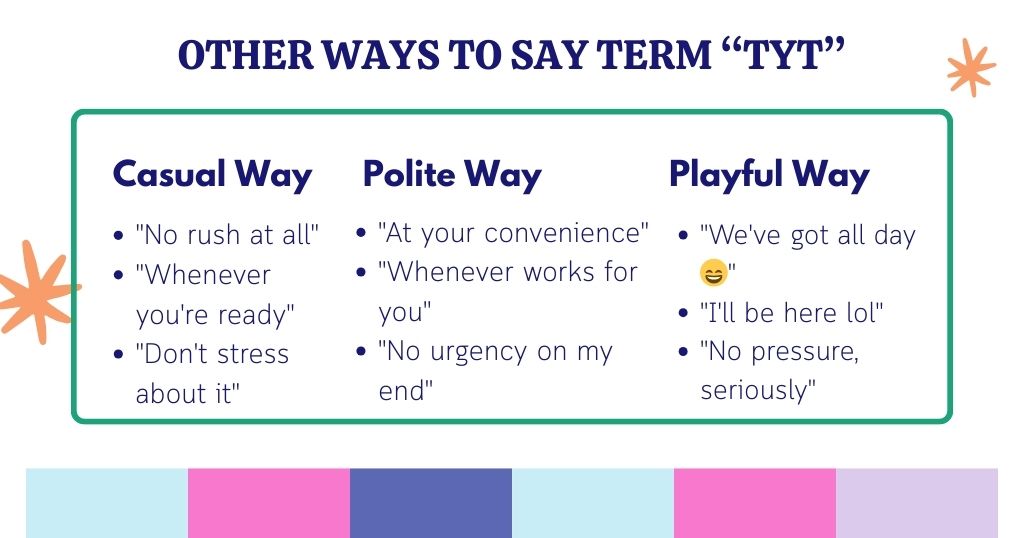
Sometimes TYT fits perfectly. Other times, you need something with a slightly different flavor:
Casual / texting a friend:
- “No rush at all”
- “Whenever you’re ready”
- “Don’t stress about it”
Some people use CB and NN to signal they’ll circle back later — it’s another low-pressure way to keep a conversation open without forcing a reply right away.
Polite / slightly more formal:
- “At your convenience”
- “Whenever works for you”
- “No urgency on my end”
Playful / joking tone:
- “We’ve got all day 😄”
- “I’ll be here lol”
- “No pressure, seriously”
None of these are robotic. They all feel real. The key is matching the energy of whoever you’re talking to.
How to Respond When Someone Sends You TYT
This is something people genuinely wonder about and nobody explains clearly.
If they’re being supportive: You don’t have to say much. A simple “thank you 🙏” or even just a heart react is completely fine. TYT is often a conversation-ender, not a conversation-starter.
If you’re not sure what they meant: Just respond naturally when you’re ready. If their message left you genuinely confused — like you’re sitting there wondering WDH they were actually trying to say — don’t overthink it. TYT is literally permission to take your time, so use it.
If it felt a little passive-aggressive: Acknowledge it gently. “Okay, I’ll get back to you soon!” keeps things moving without ignoring the subtext.
Real Examples (What These Actually Look Like)
Here are some realistic text exchanges:
“Hey, I’m still figuring out where we’re eating” / “TYT, no rush — I’m still getting ready anyway”
“Sorry I haven’t replied, work’s been wild” / “Don’t worry at all, TYT”
“Can you look over my draft when you get a chance?” / “Of course, TYT on sending it over”
“Are you coming or not??” / “tyt lol” — (sarcastic version, meaning: wow, thanks for the slow update)
“I’ll send the files soon, sorry” / “TYT, I won’t need them until Thursday”
“Still thinking about it” / “TYT, genuinely — no pressure”
These cover the range. Sweet, neutral, and the slightly shady version. Each one sounds like something a real person would actually type.
A Note on Platforms and Generations
TYT is pretty platform-neutral, but it does show up more in texting, Snapchat, and Instagram DMs than in places like Twitter or LinkedIn (where, obviously, you’d never use it).
On TikTok, there’s a small mix-up worth knowing about: TYTY often means “thank you thank you” there — not “take your time.” If you use TYT and someone responds like you thanked them, that’s probably why.
Younger people (teens, early 20s) use TYT pretty freely. Older users who didn’t grow up texting in shorthand might not recognize it at all. If you’re messaging someone in their 40s or 50s who doesn’t text slang regularly, just spell it out.
In the Philippines, TYT travels well in global work and freelance conversations — especially in remote work settings. It’s used exactly like its English meaning, no local twist on it. It just fits naturally into async communication between teams in different time zones.
Read Also: What Does TOTM Mean in Text? Real Examples from Actual Texts
Common Misunderstandings
“Does TYT mean thank you?” — No, that’s TY. Easy mix-up because of the letters, but they mean completely different things.
“Is TYTT the same as TYT?” — Not always. TYTT sometimes means “Take Your Sweet Time” (which can sound teasing) and sometimes pops up as an extended version of “thank you” on TikTok. Don’t assume they’re the same.
“Does it mean the person doesn’t care?” — Usually not. Most of the time, TYT is just someone being considerate. But if someone only ever responds with TYT every time you try to have a real conversation, that might be worth noticing.
Mostly Asked Questions About “TYT” in Chats Usage
Can TYT be rude?
Not by default, but yes, depending on the situation. In the wrong context — like responding to something urgent or emotional — it can feel dismissive. Timing and tone carry it.
Is TYT sarcastic sometimes?
Yes, definitely. “tyt lol” after a long wait is gentle shade. It’s not mean, but it’s not sincere patience either.
Does TYT mean the same thing everywhere?
Mostly yes. It’s used the same way in English-speaking countries and has traveled to places like the Philippines without changing meaning. The only real confusion is with TYTY on TikTok.
Do I have to reply to a TYT?
Nope. A heart react or emoji is more than enough. It’s not asking you a question — it’s giving you permission.
Is there a TYT meaning unrelated to texting?
Yes, actually. In Turkey, TYT refers to a national university entrance exam. Completely unrelated to chat slang — just the same letters.
One Last Thing
TYT is one of those phrases that’s simple to understand but easy to misjudge based on punctuation, timing, and who’s sending it. Most of the time, it’s just someone being genuinely low-pressure. But a little context goes a long way.
When in doubt, read the rest of the conversation — not just the three letters.

Ezell is a content writer at Celebsfloor.com with a BA in English from AUF. With eight years of experience in language education and reference writing, he focuses on creating clear definitions for slang, abbreviations, acronyms, and everyday English terms. Ezell believes language should be accessible to everyone, so he writes straightforward explanations that help students, non-native speakers, and everyday readers understand confusing words. His work emphasizes accuracy, clarity, and practical usage examples that show how terms work in real conversations and online contexts.